Film in hand, Budapest felt new. This guided analog photo trip strings together big-name Budapest landmarks with real photo time and a quick camera lesson, so you get more than sightseeing snapshots. I especially like the analog camera guidance that makes shooting feel doable, and I like that the stop entry is free for each highlight on the route. One thing to consider: the stops are short (often 5–15 minutes each), so if you want long, slow photo hangs or deep interior time, this format may feel a bit paced.
I also liked that the experience is led by Emese Tárnok, with smooth communication and a calm approach that works well for different walking speeds. The group stays small, up to 12 people, which matters when you’re learning camera basics while moving through crowds.
You start at 5:00 pm and end at Fisherman’s Bastion, with a mobile ticket and easy access to public transportation along the way. The tour runs in good weather, so plan a backup mindset if skies turn.
In This Review
- Key points that matter
- Analog Photo Trip Value: What You Pay For (And What You Don’t)
- Meeting at 5:00 pm and Walking the Loop to Fisherman’s Bastion
- The Analog Camera Lesson: Turning Confusion Into Real Photos
- Stop 1: St. Stephen’s Basilica and a Fast Lesson in Hungary’s Church
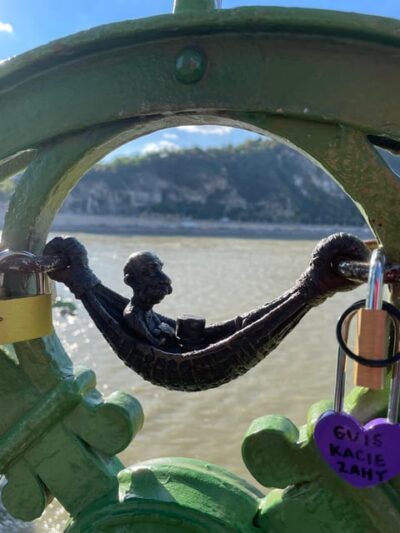
- Stop 2: Szechenyi Lanchid and the Chain Bridge Photo Setup
- Stop 3: Hungarian Parliament Building and Kossuth Lajos Square
- Stop 4: Margaret Bridge Views That Reframe the Route
- Stop 5: Matthias Church for Gothic Beauty, Quick and Focused
- Stop 6: Fisherman’s Bastion Finale and the Early-Medieval-Inspired Look
- Who This Tour Fits Best (And Who Might Want Something Different)
- Should You Book Analog Photo Trip in Budapest?
- FAQ
- Is the Analog Photo Trip offered in English?
- How long is the tour?
- Where do you meet, and where does the tour end?
- Is there a group limit?
- Do I need to pay for admission at the stops?
- What happens if the weather is bad?
Key points that matter
- Analog camera lesson included, so you’re not stuck guessing settings while the group moves.
- Multiple iconic stops in one loop: Basilica, Chain Bridge views, Parliament Square, Margaret Bridge, Matthias Church, Fisherman’s Bastion.
- Short, timed photo opportunities keep you moving, with enough moments to stop and talk about what you’re seeing.
- Free admission at the listed sights, so your money goes to the guided photo experience instead of entry fees.
- Small group size (max 12) helps the guide manage camera help and quick questions.
- 5:00 pm start gives you an evening pace for the castle area finish.
Analog Photo Trip Value: What You Pay For (And What You Don’t)
At $142.97 per person for about 3 hours 30 minutes, you’re paying for a specific combo: a guided walking route plus the hands-on analog photography experience. The value is strongest because the route hits major Budapest landmarks while keeping on-the-spot costs low.
One big plus: the stops list admission ticket free at each location on the itinerary. That means you’re not juggling separate ticket purchases while you’re trying to focus on composing shots. Instead, your time stays focused on learning, framing, and capturing photos on film-style gear.
Another value driver is the guide’s role. The tour includes a brief instruction on the analog cameras, and the guide stays with you long enough to make the process feel simple. In plain terms: you’re not just paying to be taken to sights. You’re paying for someone to help you actually use the camera before the “best view” moment passes.
The only real trade-off with the price is the pace. With multiple highlights and short time blocks at each stop, you won’t linger for long photo sessions at every viewpoint. You’re aiming for a smart highlights-and-composition route, not a slow, choose-your-own-adventure day.
You can also read our reviews of more tours and experiences in Budapest.

Meeting at 5:00 pm and Walking the Loop to Fisherman’s Bastion
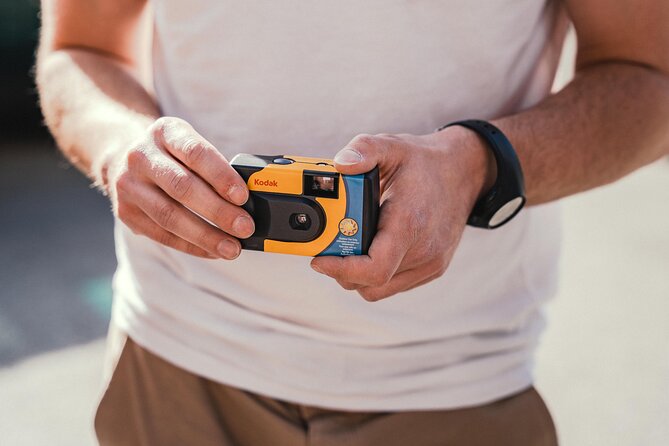
This tour starts at CBI CompareBudapest, Anker köz 2-4, 1061 Hungary and ends at Fisherman’s Bastion, Budapest, 1014. You’ll want to plan to arrive a few minutes early so you don’t feel rushed getting checked in and set up for your camera lesson.
It’s designed as a walk-and-stop format. The timing is tight but not frantic: think about quick orientation, then short viewing windows that still leave room to talk. You’ll see how that works best if you’re comfortable walking between major points and stopping when the guide cues you.
The tour is also built for practical travel days. It’s near public transportation, so you can connect from elsewhere in the city without complicated logistics. And since it’s capped at 12 people, the pace is manageable for a small group moving as a unit.
The Analog Camera Lesson: Turning Confusion Into Real Photos
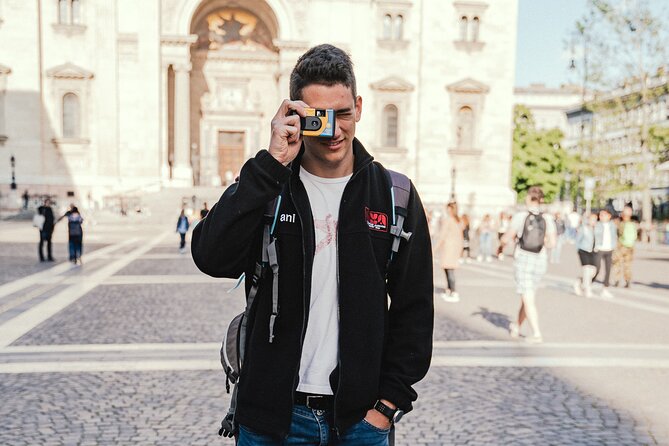
If analog photography is new for you, this is the part that makes the whole trip click. The tour includes a brief instruction about the analog cameras, and the guide helps you learn how to use them during the walk—so you don’t end up treating the camera like a mystery box.
I like that the lesson is short enough to stay practical, but the guide still gives you help as you go. That matters because with analog-style shooting, you can’t just spray-and-pray like on a phone. Your shots feel more deliberate, which is exactly what makes the souvenir photos more meaningful.
Another detail I value: you’re not expected to be an expert on day one. The vibe is about getting you comfortable quickly, then letting you focus on the views. That’s why the group spends time at each viewpoint rather than only pointing and moving.
Finally, you get a physical takeaway. Several people highlight the analog photos as the best souvenir—something you’ll hold in your hands later, not just pixels in a camera roll.
Stop 1: St. Stephen’s Basilica and a Fast Lesson in Hungary’s Church
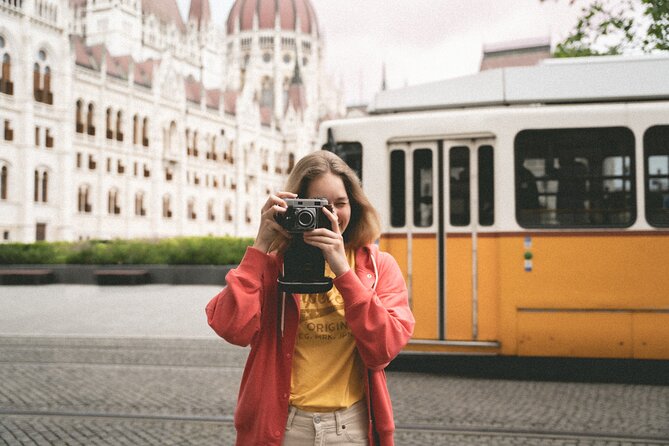
You begin with St. Stephen’s Basilica (Szent Istvan Bazilika). The goal here is simple: take a close look and learn some context about why this is such a central church in Hungary.
Your time block is about 15 minutes, which is perfect for a first orientation without turning it into a marathon. You’ll have time to settle your bearings, spot key details, and get a sense of what makes this church important before you move on.
The practical upside of starting here is that it sets the theme for the whole tour: Budapest isn’t only scenic. It has story layers, and this stop is a fast way to connect the architecture to the country’s identity.
The only potential drawback is timing. If you were hoping for a long, in-depth church visit, the schedule won’t give you that. This is a guided intro-and-photo rhythm, not a full sightseeing day.
Stop 2: Szechenyi Lanchid and the Chain Bridge Photo Setup
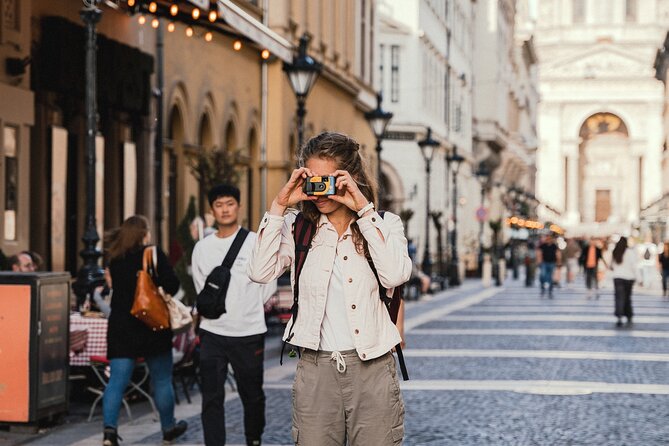
Next up is Szechenyi Lanchid, where the tour focuses on views before you head onto the tram route (specifically around Tram 2). You’ll aim your camera at the Chain Bridge, with Buda Castle in the background.
This is where the analog format shines. Film-style shooting encourages you to slow down enough to frame a shot instead of just snapping at whatever is in front of you. The guide’s cue-and-time structure helps you concentrate on the composition: bridge lines, background scale, and how the city layers stack up.
Your time here is also about 15 minutes, so you’ll get at least a couple of chances to try different angles rather than one rushed attempt. And since the goal is a specific viewpoint, it’s easier to tell what to look for and why that spot matters.
If you’re sensitive to crowds, be ready for that in this central area. Still, the short stop time helps you avoid being stuck waiting too long.

Stop 3: Hungarian Parliament Building and Kossuth Lajos Square
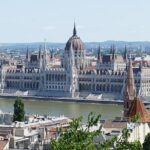
Then you shift to the Hungarian Parliament Building, paired with a look around Kossuth Lajos square. The focus is both visual and historical: you’ll learn about the place while also taking in the surroundings.
Your stop time is about 15 minutes. That’s enough to see the square’s layout and take photos that include more than just the building. In a city like Budapest, context matters, and the guide’s history angle helps you frame your shots with a little meaning behind them.
This is also a good stretch for analog practice. The architecture offers clean photo subjects: strong lines, repeated details, and a clear “center of interest” to aim at.
Again, the pacing is the trade-off. You won’t get a long deep-dive or extended interior time here, but you do get a guided understanding plus a focused photography moment.
Stop 4: Margaret Bridge Views That Reframe the Route
From there, you reach Margaret Bridge for a viewpoint that’s about perspective. The tour’s description is key: from this bridge, you get a view back at where you’ve been and toward where you’re going next.
Your time here is about 15 minutes, and I like this stop because it acts like a visual checkpoint. After seeing Parliament and the bridge zone, looking back helps you connect the pieces of the city. Then you can look ahead with anticipation, especially since the castle district is coming.
For analog shooting, bridges are practical. They naturally create leading lines, and moving slightly can change your composition without you needing to walk far. The short time window keeps you focused on experimenting rather than wandering.
If the weather is windy or changeable, be ready. Even if you’re not stuck indoors, conditions can affect how long you comfortably stand at a viewpoint.
Stop 5: Matthias Church for Gothic Beauty, Quick and Focused
You then go to Matthias Church, where the emphasis is on its stunning Gothic look. This is a short stop, about 5 minutes, so it’s not about a full viewing session.
What I like about a very short stop like this is that it turns into a “hit the key details” moment. The guide’s focus helps you know what to notice fast, then you shoot and move on. For analog cameras, that’s especially useful. You don’t want to burn lots of frames before you understand what makes the subject special.
If you want to linger, you might feel it here—5 minutes is brief. But as part of an overall 3.5-hour loop, it keeps the tour flowing toward the big finish.
Stop 6: Fisherman’s Bastion Finale and the Early-Medieval-Inspired Look
The tour ends at Fisherman’s Bastion, after arriving in the Castle District. This stop is about atmosphere and style: the architecture is inspired by early medieval times.
Your time block is about 15 minutes. This is the perfect length for analog shooting at a high-value viewpoint. It gives you enough time to settle in, frame a shot, and try a couple of compositions before you wrap.
The “finish here” setup is smart for photography. Fisherman’s Bastion is a place where city views make sense, and the early-medieval-inspired style gives your photos a distinct visual tone. The best part is that you’re not only collecting images—you’re ending with a setting that feels like a destination, not just another stop.
Since the tour ends here, you can also continue exploring on your own afterward with the photos you already captured as your souvenir anchor.
Who This Tour Fits Best (And Who Might Want Something Different)
This experience fits you if you want a guided walking route that includes photo time plus a quick, friendly analog camera lesson. It’s also a great choice if you like getting context while you’re on the move—church, Parliament, bridges, and castle views all in one afternoon-to-evening rhythm.
It also works well if you’re traveling with a partner or friends. The small group size helps it stay relaxed, and the guide approach is patient enough for slower walkers. In other words: this is not a “keep up or lose the shot” tour.
The main reason you might skip it is the schedule style. Because stops are short and you’re hitting multiple highlights in about 3.5 hours, it’s not the best fit for people who want long museum-style stays or slow, lingering photography sessions at just one location.
Should You Book Analog Photo Trip in Budapest?
I’d book this if you want a smart mix of Budapest highlights and a hands-on analog souvenir. The price makes more sense when you see what’s included in practice: a small-group guide, an analog camera lesson, multiple photo stops, and free admission at the listed landmarks.
Book it if:
- You’re curious about analog photography and want instruction without stress.
- You like structured routes that still include viewpoints where you can experiment.
- You want physical photos as a memorable takeaway.
Skip it if:
- You need lots of long time at any single interior site.
- You prefer flexible, unstructured wandering over a timed highlights loop.
- Weather changes stress you out, since the tour is weather dependent.
If your idea of a good Budapest afternoon is seeing major sights with a purpose—and leaving with real photos—this is a strong match.
FAQ
Is the Analog Photo Trip offered in English?
Yes. The tour is offered in English.
How long is the tour?
The duration is about 3 hours 30 minutes.
Where do you meet, and where does the tour end?
You start at CBI CompareBudapest, Anker köz 2-4, 1061 Hungary and end at Fisherman’s Bastion, Budapest, 1014.
Is there a group limit?
Yes. The tour has a maximum of 12 travelers.
Do I need to pay for admission at the stops?
The itinerary lists admission ticket free for each stop, including St. Stephen’s Basilica, Szechenyi Lanchid viewpoint, the Parliament area, Margaret Bridge, Matthias Church, and Fisherman’s Bastion.
What happens if the weather is bad?
This experience requires good weather. If it’s canceled due to poor weather, you’ll be offered a different date or a full refund.