Budapest has layers. This private Jewish Quarter walk links synagogues, ghetto-era street corners, and Holocaust memorials into one logical route, with stops chosen to fit what you want to see. I especially like the way the guide turns buildings into stories you can actually picture, and I love that you get food tastings along the way instead of just being “shown stuff.” One thing to plan for: not all synagogue entrances are included, so a ticket fee (especially at the Great / Central Synagogue) can pop up if you’re not expecting it.
The other standout is the guide energy. In multiple guides’ styles, the same theme comes through: patience with questions and a careful, respectful tone at the somber sites. I’d also flag timing: it’s about 4 hours of walking and listening, so wear comfy shoes and be ready for a full, moving half-day—plus it’s not recommended on Saturdays because the synagogues are closed for Jewish holidays.
In This Review
- Key things you’ll notice on this tour
- Why this Jewish Quarter route works (and not just as a checklist)
- Price and what you’re really buying for $342.93 per group
- Pickup, timing, and the pace of a 4-hour private walk
- Stop-by-stop: what you’ll see and why each one matters
- Stop 1: The Jewish Quarter streets and ghetto wall remnants
- Stop 2: Great / Central Synagogue (Nagy Zsinagóga, Dohány Street)
- Stop 3: Kazinczy Street Synagogue (outside only)
- Stop 4: Rumbach Street Synagogue (newly renovated; inside by request)
- Stop 5: Carl Lutz Memorial
- Stop 6: Szimpla Kert and the ruin-bar neighborhood feel
- Stop 7: Shoes on the Danube Bank
- Stop 8: Király Street and an original ghetto segment
- Guides make or break this kind of tour (and here they’re strong)
- Food tastings: small break, real payoff
- What to watch for before you go
- Who this tour is best for
- Should you book it?
- FAQ
- Is this a private tour?
- How long is the Jewish Budapest Private City Walk?
- What’s included in the price?
- Are synagogue entrance tickets included?
- Can I enter Kazinczy Street Synagogue?
- Is pickup available?
- Is the tour offered on Saturdays?
- Is food included?
Key things you’ll notice on this tour
- Private group up to 15 with hotel/port pickup, so you can move efficiently through Pest’s Jewish landmarks
- Dohány Street (Great / Central) Synagogue is a must-see, but entry isn’t included unless arranged
- Kazinczy Street Synagogue is outside-only on current dates due to renovation and restrictions
- Carl Lutz Memorial and Shoes on the Danube Bank add serious context to the Holocaust story
- Food tastings and at least one planned stop for a sweet bite make the tour feel less like a school lesson
- Guides named Suzy, Joel, and Bogato are repeatedly praised for patient answers and adapting to the group
Why this Jewish Quarter route works (and not just as a checklist)
The Jewish Quarter in Budapest can feel like a puzzle when you visit alone. Streets look ordinary. Buildings look beautiful. But without the right thread, it’s hard to connect what you’re seeing to what happened there.
This tour solves that. You walk a route that moves from the physical leftovers of the ghetto—like remaining wall segments and yellow-star houses—toward the places where community life survived, resisted, and rebuilt. Then it pivots to memory sites that don’t let you forget what the Arrow Cross terror did along the Danube.
You’re not rushing between random attractions. The pacing is built around meaning. And because it’s private, your guide can slow down when your group wants more detail—or shift the order a bit if you want to prioritize architecture versus memorial sites.
You can also read our reviews of more city tours in Budapest


Price and what you’re really buying for $342.93 per group
At $342.93 per group (up to 15 people), the value depends on how full your group is.
- If your group fills close to 15, it can work out to roughly the low-to-mid $20s per person.
- If it’s a smaller group—say, a handful of people—the per-person cost rises fast.
So what are you paying for? Not just walking and photos. You’re paying for a guide who can:
- connect synagogue design and community history in clear, human terms
- handle questions without flattening the experience into one-way lecturing
- keep the route tight enough that you don’t waste time hunting for the next stop
Also, food tastings are included. That helps offset cost because you don’t have to plan snacks separately while you’re in the middle of a meaningful (and sometimes emotionally heavy) walk.
Pickup, timing, and the pace of a 4-hour private walk
This is set up as a private tour, so only your group participates. You can get hotel or port pickup and drop-off, including for cruise ship passengers (they’ll need your ship name plus docking, disembarkation, and re-boarding times).
The tour runs about 4 hours. That’s long enough to feel complete, but still short enough that you can stack other Budapest highlights afterward. The catch is the walking + listening combo. Reviews repeatedly mention the guides keeping things un-rushed and patient. Still, you should plan for steady foot time and expect you’ll sit still only briefly.
If you’re visiting on a Saturday: don’t count on synagogue interiors. The tour notes it’s not recommended for Saturdays because the synagogues are closed for Jewish holidays. On those days, you may lose some of the “inside the building” magic.
Stop-by-stop: what you’ll see and why each one matters
Stop 1: The Jewish Quarter streets and ghetto wall remnants
You start in Budapest’s Jewish Quarter with the physical leftovers of the former ghetto—remaining parts of the wall and yellow-star houses. Even if you’ve read about ghettos before, seeing the street layout and the preserved fragments changes how the story lands. It stops being abstract and becomes spatial.
Admission at this stop is free (a ticket is listed as free). That’s one of the nicer budgeting points: you’ll get early context without paying to get in somewhere.
A small consideration: this is a topic-heavy start. If your group needs quick warm-up (like photos, light context, or a bit of humor early on), ask your guide to set the tone right away.
You can also read our reviews of more private tours in Budapest



Stop 2: Great / Central Synagogue (Nagy Zsinagóga, Dohány Street)
This is the big architectural anchor: the Great / Central Synagogue, also called the Dohány Street Synagogue. The tour frames it as the biggest functioning synagogue in Europe, and the building’s look is a major part of why people remember it.
Here’s the practical part: entry is not included. The itinerary notes it clearly, and at least one review experience is a reminder that it can surprise people if they assumed everything was covered.
If you do pay to enter, this becomes more than sightseeing. You’ll get historical context tied directly to where things are inside and how the building relates to the community’s turbulent 20th-century story. The guide can take you through the whole building upon request for an extra entrance fee, so if your group wants the full experience, speak up early.
Stop 3: Kazinczy Street Synagogue (outside only)
The tour includes the Kazinczy Street Synagogue, an early-1910s building with Art Nouveau traits. But there’s a reality check: it’s closed temporarily due to renovation and there’s also a community ban, so you cannot enter right now. You’ll see it from the outside.
This is one of the places where a private tour still works well, because your guide can explain what you’d normally see inside and why it matters, even if the doors are closed. Still, if synagogue interiors are the top priority for your trip, this stop is a “sights from outside” moment, not a full-entry moment.
Stop 4: Rumbach Street Synagogue (newly renovated; inside by request)
Next up is the Rumbach Street Synagogue. The building is described as recently renovated, and the architecture is part of the appeal. This stop also has a ticket wrinkle: the tour doesn’t include entry, but you can request to see inside.
That request detail is useful. If your group includes people who care about architecture (or you’ve come specifically for synagogue interior experiences), you’ll want to make that ask when your guide can still adjust the plan.
Stop 5: Carl Lutz Memorial
Then the tone turns solemn in the best way. At the Carl Lutz Memorial, you pause at a public statue and discuss the Swiss diplomat who helped thousands of Jewish people avoid the death camps during the Holocaust.
This is the kind of stop that turns history into a question: what does bravery look like when it’s risky and messy? Your guide walks you through the story and puts it into context with the broader horrors of the era—without turning it into sensationalism.
Admission is free here. Emotionally heavy sites don’t always have to come with extra fees, and that’s the case.
Stop 6: Szimpla Kert and the ruin-bar neighborhood feel
Right after memorial weight, the route shifts to a lighter street atmosphere with Szimpla Kert. This is part of Budapest’s famous ruin bar scene, and the tour points out the design and atmosphere that pull people from around the world.
You’re not going here for a party plan. Think of it as a breather in the urban story. You’re seeing how the neighborhood exists today after everything that happened there. It helps you understand time travel isn’t only for museums; it’s for streets, too.
Admission here is listed as free.
Stop 7: Shoes on the Danube Bank
One of the most emotionally direct memorials in the city is Shoes on the Danube Bank. The tour frames it as remembrance for people who were shot into the Danube during the Arrow Cross terror.
The listed time here is long—1 hour—so treat this as a sit-with-it stop, not a quick photo line. If your group is prone to rushing through memorials, this is where your guide’s tone and pacing matter most. The goal is to make the meaning land, not just capture the image.
Admission is free.
Stop 8: Király Street and an original ghetto segment
You finish with Király Street, under Király str. nr. 15, where an original segment of the Great Ghetto can be found. The route connects this directly to the fact it was the second largest WWII ghetto of the world.
This last stop is a way to re-anchor everything you learned. After the Danube memorial, you return to the street-level footprint—where forced housing and daily life constraints played out in real space.
Admission is free.
Guides make or break this kind of tour (and here they’re strong)
You’re dealing with architecture, history, and grief in one half-day. That’s a lot. A strong guide matters.
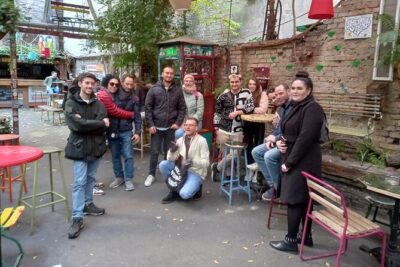
The guide names that come up repeatedly—Suzy, Joel, and Bogato—share the same trait: patient explanations. Joel is called out for being patient with a group that included people over 70. Suzy is repeatedly praised for being passionate, warm, and thorough, including for patiently answering lots of questions. Bogato is noted for flexibility and a friendly style that kept things moving without feeling rushed.
If you’re the sort of person who asks many questions—or if your group includes different ages and interests—this guide setup is a strong match.
Food tastings: small break, real payoff
Food is built into the tour in a useful way. The experience includes food tastings and breaks up the walking with a snack stop. One review even mentions a stop at the Strudel House during the tour.
So instead of treating your Jewish Quarter visit as “history only,” you get a more normal traveler rhythm: walk, learn, snack, continue. It’s also a practical way to keep energy stable during memorial-heavy parts of the route.
Alcoholic drinks are not included (you can buy them), and lunch is not included either. So think of this as tasting-level food, not a full meal.
What to watch for before you go
This tour is very well structured, but a few details can save you from awkward surprises:
- Synagogue entrance fees: Great / Central Synagogue is not included, Kazinczy is outside-only, and Rumbach is ticketed (but entry may be possible upon request).
- Saturday closures: If your dates fall on Saturday, synagogue interiors won’t work the way they do on other days.
- Walking time: Even though it’s private and flexible, it’s still a half-day with real foot time.
- Respectful context: You’re going to memorials tied to persecution and violence. Bring a calm mindset, and expect the guide to set an appropriate tone.
Who this tour is best for
I think this is a smart choice if you:
- want a guided route through the Jewish Quarter that connects sites into one story
- care about synagogue architecture but also want the historical reasons behind what you’re seeing
- prefer a private experience where your pace and questions matter
- want a tour that includes food tastings, not just a list of stops
It’s also ideal for mixed groups—families with older relatives, friends with different interests, or anyone who doesn’t want to figure out transit and logistics while trying to understand an emotionally complex neighborhood.
Should you book it?
I’d book it if you want a half-day that feels like you understand the neighborhood—not just the sights. The route includes the major landmarks you’d search for anyway, but the real value is how the guide connects ghetto remnants, synagogue buildings, Holocaust memorials on the Danube, and today’s neighborhood vibe.
I’d think twice if your dates are a Saturday, or if your budget is strict and you want zero chance of extra ticket costs for synagogue interiors. The biggest “watch out” here is the Dohány Street Synagogue entrance fee not being included, and the fact that Kazinczy and some entries are limited.
If you’re flexible about that—and you want real context in clear, respectful language—this is the kind of tour that makes Budapest feel understandable fast.
FAQ
Is this a private tour?
Yes. It’s a private tour/activity, and only your group will participate.
How long is the Jewish Budapest Private City Walk?
The duration is approximately 4 hours.
What’s included in the price?
Included are a local guide, a professional guide, hotel/port pickup and drop-off, and the private tour. The experience also includes food tastings, but entrance fees are not included in general.
Are synagogue entrance tickets included?
No. The Great / Central Synagogue (Nagy Zsinagóga) is listed as not included. Kazinczy Street Synagogue is closed and cannot be entered during renovation. Rumbach Street Synagogue tickets are not included, though the guide may show you inside upon request.
Can I enter Kazinczy Street Synagogue?
Not right now. It is closed temporarily due to renovation and there is a community ban, so you can only see it from the outside.
Is pickup available?
Yes. Hotel and port pickup and drop-off are offered. Cruise ship passengers need to provide ship name and docking/disembarkation/re-boarding times.
Is the tour offered on Saturdays?
It is not recommended on Saturdays because Jewish holidays mean the synagogues are closed.
Is food included?
Yes. Food tastings are included during the tour. Lunch is not included.