REVIEW · BUDAPEST
Communist Budapest Walking Tour
Book on GetYourGuide →Operated by insightcities.com · Bookable on GetYourGuide
Budapest reads like a history textbook in asphalt. This Communist Budapest Walking Tour turns key landmarks into a clear, site-by-site look at how Hungarians got small freedoms under totalitarian pressure, especially around the 1956 uprising. I love the historian-led storytelling and the way it connects propaganda-era design to real political control, but one watch-out: if you already know Hungary’s late-20th-century history well, you may find the tour moves through some topics at a basics-to-context pace.
It’s also practical: you’re on your feet for a three-hour loop with metro and a short trolley ride, so it’s not a sit-and-watch kind of tour. It’s run in English by academic and media types, so the facts come with interpretation, not just dates and plaques.
In This Review
- Key Highlights You’ll Actually Use
- Communist Budapest, Goulash-Style: What This Tour Tries to Explain
- Bem József Square: Starting With the 1956 Uprising’s First Big Spark
- Metro to Kossuth Square: Parliament, Monuments, and 1956’s Visible Aftermath
- Freedom Square’s Cold War “Stone Set”: U.S., Soviet, Reagan, and an Atomic Shelter
- 1970s Housing Estates on the Edge of the City: Hope Wrapped in Concrete
- Puskas Stadium (Former People’s Stadium): Socialist Realist Statues With a Job to Do
- Stalin’s Trolley Bus to Dozsa György Street: May Day Parades and Then-Now Photos
- House of Terror and the Berlin Wall Slab: Where Ideology Meets Documented Crime
- Price and Value: Is $123 Worth It for 3 Hours?
- Who Should Book This Tour (and Who Might Want Something Else)?
- FAQ
- How long is the Communist Budapest Walking Tour?
- Where does the tour meet?
- Is it walking-only, or does it include public transport?
- What language is the tour offered in?
- Who are the guides for this tour?
- What are the main stops on the itinerary?
- Is it a group tour or can I go privately?
- Is free cancellation available?
Key Highlights You’ll Actually Use
- Bem József Square and the 1956 opening demonstration that set events in motion
- Kossuth Square + Parliament monuments tying 1956 political chaos to visible memorials
- Freedom Square’s Cold War “four-stone” set-up with U.S., Soviet, Reagan, and an atomic shelter entrance
- 1970s housing estates where modern conveniences (like elevators) meant big hope for families
- Puskas Stadium (former People’s Stadium) and Social Realist statues of workers, soldiers, and intellectuals
- House of Terror and the Berlin Wall slab for a hard turn from ideology to documented crimes
Communist Budapest, Goulash-Style: What This Tour Tries to Explain
Budapest’s communist era isn’t just one single look or one single policy. It’s a long stretch where power stayed firm, but everyday life could feel… oddly negotiable. This tour frames that tension with a simple idea: the system offered some small liberties, yet demanded obedience on major issues.
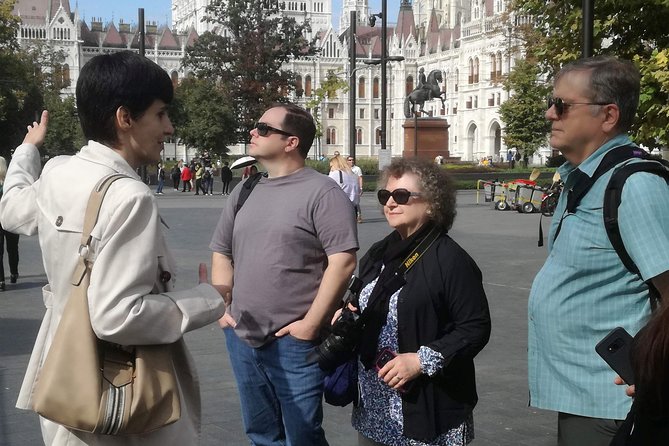
You don’t just get a list of sights. You get a guided walk that tries to answer a more useful question: what did these spaces do to people’s minds and routines? The route is built to show propaganda, resistance, and everyday aspiration in the same day, so the story clicks faster than reading it at home.
A quick note on pace. This is three hours of walking plus public transit. Reviews praise the relaxing tempo, but the format still adds up—good if you like motion and context, less good if you want a slow museum-and-coffee afternoon.
You can also read our reviews of more walking tours in Budapest

Bem József Square: Starting With the 1956 Uprising’s First Big Spark
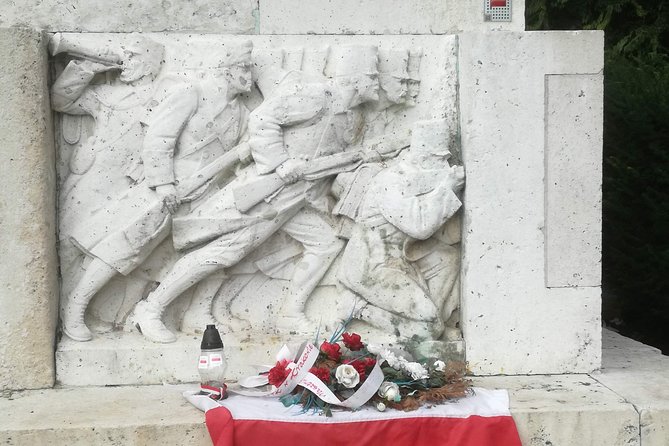
The tour kicks off at Bem József Square, and the guide sets the scene around the first large demonstration of the 1956 uprising. That starting point matters. It’s one thing to know the dates of 1956; it’s another to begin where the energy first spilled into the streets.
From there, you’ll also have a small “period detail” moment with a coffeehouse that has kept its original interior from the 1960s. It’s a quiet contrast: the same city that hosted political power plays also kept regular social rituals—talk, coffee, daily life—going under strict oversight. Small details like this help you feel how propaganda sits next to ordinary habits.
Practical tip: keep your camera ready here. The square and nearby streets give you the right baseline for the rest of the walk, and the guide often uses those early visuals to explain what changed later.
Metro to Kossuth Square: Parliament, Monuments, and 1956’s Visible Aftermath
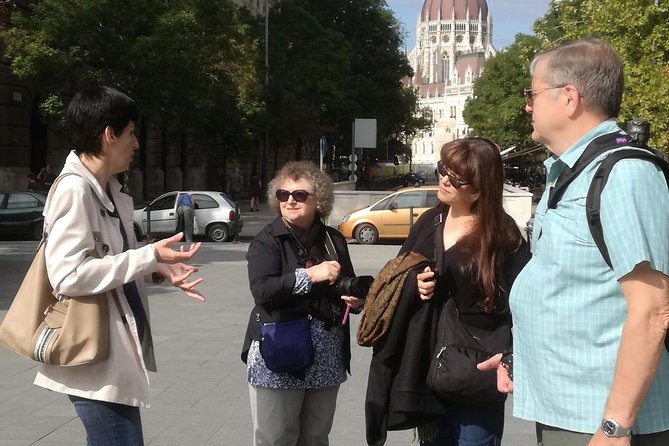
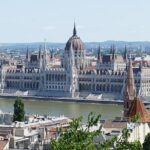
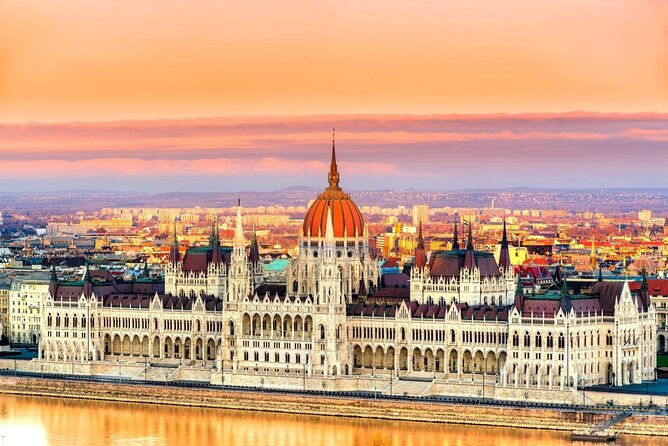
Next comes the metro ride to Kossuth Square, where the tour shifts from origin story to consequence. Standing in front of the Hungarian Parliament, you’ll see monuments connected to the political and armed conflicts of 1956.
This is where the tour’s approach gets especially useful. Instead of treating monuments like background art, the guide connects them to how the state and society tried to process trauma, shape memory, and control interpretation. In other words, you’re not only looking at history—you’re looking at how history was packaged.
If you’re the kind of person who likes to understand why certain plaques exist and what they were meant to do, you’ll enjoy this section. It’s one of the places where the tour’s academic tone stays practical.
Freedom Square’s Cold War “Stone Set”: U.S., Soviet, Reagan, and an Atomic Shelter
Then you head to Freedom Square, where the Cold War is translated into four visible stone symbols:
- the U.S. embassy
- a monument to the Soviet army
- a statue of President Ronald Reagan
- the entrance to a secret atomic shelter
This stop is a strong example of why the tour is worth more than a photo walk. You’re not just seeing a “cool square.” You’re seeing how global rivalry got pressed into local geography—how the fear of nuclear conflict became architecture and landmarks.
It also helps you understand the psychological environment of the era. When you walk through a place like this, you can feel the message: the world is watching, power is everywhere, and survival plans can be hidden underground.
1970s Housing Estates on the Edge of the City: Hope Wrapped in Concrete
After the next metro transfer, you’ll reach 1970s housing estates at the edge of the city center. From a distance, these blocks can look drab and grey. But the guide explains why, at the time, many young families were genuinely excited: being assigned an apartment in these new estates meant access to conveniences older buildings didn’t have.
The tour calls out things like elevators and modern conveniences—simple features today, life-changing upgrades then. This part is important because it prevents the “communism = only misery” version of events. The reality is more complicated: people could benefit from certain improvements while still living under political constraints.
I like how the guide asks you to compare past and present without sugarcoating. You’re allowed to see the concrete, and you’re also allowed to see the human logic behind it.





Puskas Stadium (Former People’s Stadium): Socialist Realist Statues With a Job to Do
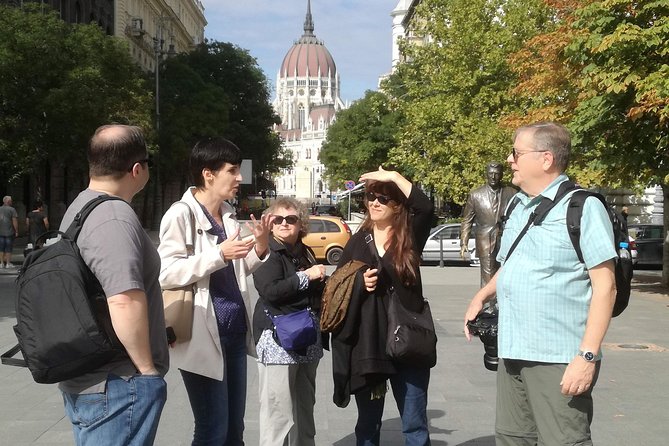
One of the most visually distinctive stops comes at the former People’s Stadium, now Puskas Soccer Stadium. This is one of the few spots in Budapest where you can see typical Social Realist statues of heroic workers, soldiers, and intellectuals—figures presented as guiding the public toward a bright future.
This is propaganda art, but it isn’t just “art for art’s sake.” The guide uses the statues to explain what the regime wanted people to believe: that the right kind of citizen looked like the painted ideal. When you stand near those figures, you can connect the ideology to the physical landscape.
If you’re interested in public art, political messaging, or the way regimes manufacture optimism, this stop delivers. It’s also a good one to photograph, as long as you keep your focus on the guide’s explanation—not just the statue silhouette.
Stalin’s Trolley Bus to Dozsa György Street: May Day Parades and Then-Now Photos
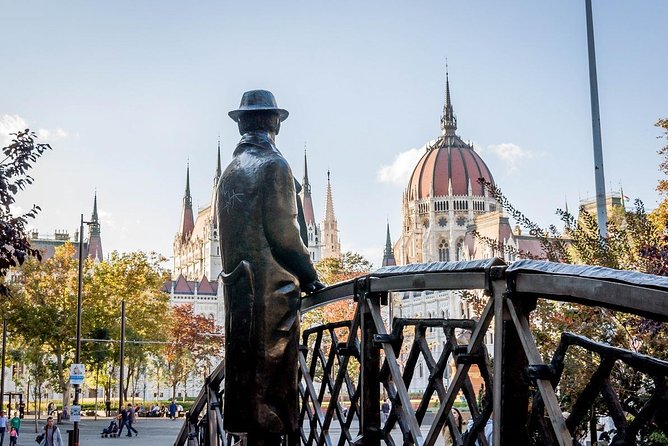
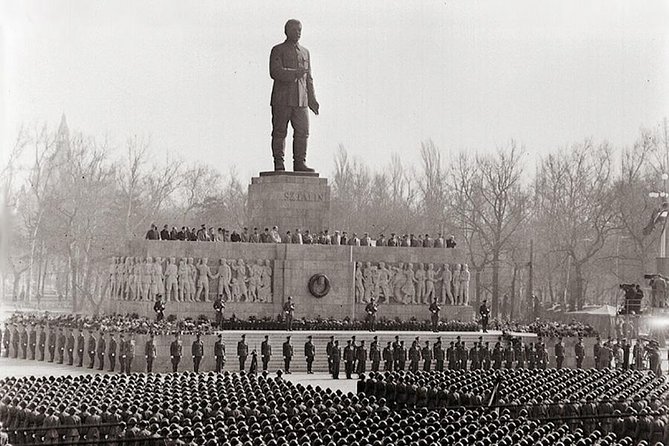
From there, you’ll take a short ride in one of Stalin’s trolley buses to Dozsa György Street, a broad boulevard used for May Day parades.
This segment works because it’s not theoretical. You’re physically moving along a route tied to mass ceremony. The tour then uses an iPad and old photos to show the contrast between how the area looked during Stalin’s era and what you see today.
That then-and-now method is one of the strongest teaching tools on the route. You don’t just hear about planning and staging—you can compare the space with your own eyes. It makes the ideology feel less like a textbook concept and more like a timed performance that shaped public behavior.
House of Terror and the Berlin Wall Slab: Where Ideology Meets Documented Crime
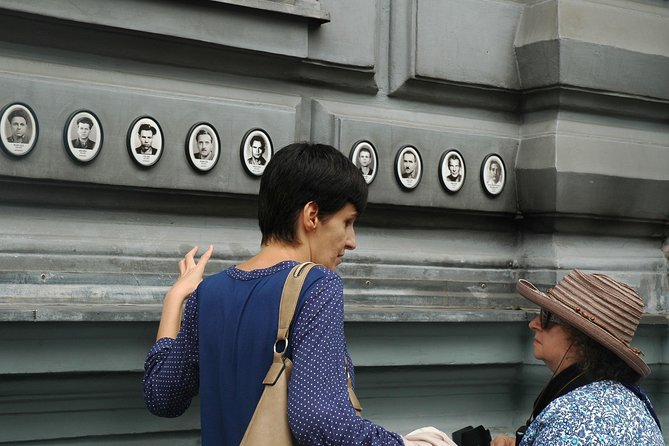
Finally, the tour ends with a hard pivot to the House of Terror, housed in the former headquarters of the secret services. The museum commemorates the crimes of communism, with emphasis on the Stalinist years.
In front of the building, you’ll see a slab of the Berlin Wall. It’s a blunt visual reminder that the communist world wasn’t only an idea—it was also a system that relied on fear, surveillance, and coercion.
This ending isn’t about making you sad for the sake of it. It’s about closing the loop the tour started earlier: propaganda, control, and the lived consequences. By the time you reach this stop, the earlier landmarks start to read differently. They stop being just architecture and start looking like tools.
Price and Value: Is $123 Worth It for 3 Hours?
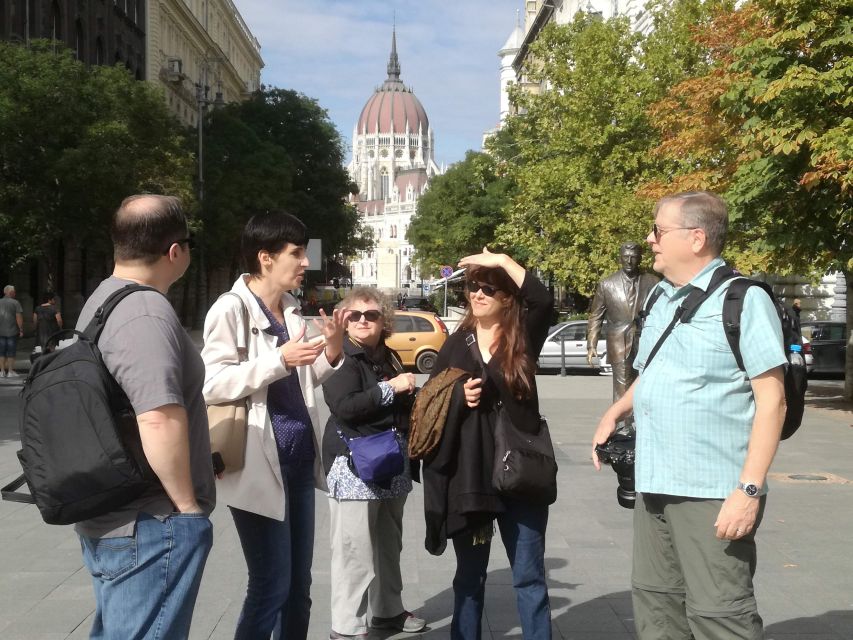
At $123 per person for a three-hour tour, you’re paying for two things: access to a historian guide and a tightly designed route that links sites you might otherwise visit in random order.
Here’s the value logic I’d use to decide:
- You’re not just covering landmarks; you’re connecting political events (1956) to Cold War framing (Freedom Square) and everyday life (1970s housing).
- The guide background is serious—professors, doctoral students, historians, journalists, art critics, and published authors—so you’re getting interpretation, not only walking directions.
- You do have some extra costs to plan for: tram and metro tickets are not included, so budget for the transit.
If you want a deep, museum-style experience, this tour is shorter than that. But if you want a guided “map” of communist-era Budapest that helps you understand what you’re seeing, the price feels aligned with the time and the specialized commentary.
Who Should Book This Tour (and Who Might Want Something Else)?
This tour is a great fit if you’re:
- new to Hungary’s post-WWII era and want a guided route that makes the timeline easier
- curious about how politics shaped public spaces, art, and housing
- the kind of traveler who likes photos, comparisons, and place-based explanation
It may be less ideal if you’re already comfortable with the period. One piece of feedback suggests that when you bring prior knowledge, the tour can feel closer to a basic overview than a deeper dive into day-to-day life and the end of communism. Put simply: it’s built to teach, not to test your syllabus.
If you’re choosing only one tour to start orienting yourself in Budapest’s ideological geography, I’d lean toward booking this—especially if you enjoy walking, short transit jumps, and a guide who ties facts to the way places work.
FAQ
How long is the Communist Budapest Walking Tour?
It runs for about 3 hours.
Where does the tour meet?
The meeting point is Bambi Eszpresszó, Frankel Leó út 2/4, 1027 Budapest, Hungary.
Is it walking-only, or does it include public transport?
It’s a walking tour with metro included during the route and also a short trolley bus ride. Tram and metro tickets are not included.
What language is the tour offered in?
The live guide tour is available in English.
Who are the guides for this tour?
The guides are professors, doctoral students, historians, journalists, art critics, and published authors.
What are the main stops on the itinerary?
You’ll visit Bem József Square, Kossuth Square, Freedom Square, 1970s housing estates, the former People’s Stadium (now Puskas Soccer Stadium), Dozsa György Street, and end at the House of Terror.
Is it a group tour or can I go privately?
The tour is available as private or small groups.
Is free cancellation available?
Yes. You can cancel up to 24 hours in advance for a full refund.
Should you book it? If you want communist-era Budapest explained through real corners of the city—squares, monuments, housing, stadium statuary, and the House of Terror—this route is a smart way to get oriented fast. If you already know every major milestone and want heavier focus on daily life and the endgame of the system, you might look for a more specialized follow-up tour instead.